MODEL CLF FIRE SAFETY ARRANGMENTS
Introduction
It is the overall aim of Waycroft Academy to minimise the risks of fire to employees, students, visitors, volunteers and contractors. This will be achieved by ensuring precautions are taken to avoid fires occurring and by ensuring that procedures are in place for the prevention of fire.
The aims of the arrangements are:
- To ensure compliance with all relevant legislation.
- To undertake suitable and sufficient fire risk assessments of all parts of the premises and activities within premises.
- To identify and implement reasonably practicable control measures to control risks from fire.
- To conduct regular fire evacuation drills and fire safety inspections.
- To ensure all fire-related equipment is inspected and maintained within the legal timescales.
- To ensure effective liaison with the local fire authority where appropriate.
- To ensure Fire awareness training is conducted by all staff.
Application
- These procedures, precautions and prevention apply to all employees, students, visitors, volunteers and contractors on the academy premises.
- These arrangements will be made available to all employees and others (detailed above) as appropriate.
Legal and other references
- The Regulatory Reform (Fire Safety) Order 2005
- Health and Safety at Work etc. Act 1974
- Management of Health and Safety Regulations 1999
- Department of Communities and Local Government “Fire Safety Risk Assessment- Educational Premises.”
Roles and Responsibilities
- The Principal or appointed deputy is the ‘Responsible Person’ for fire safety matters at the academy. They will co-ordinate the implementation of fire safety measures, ensure that staff and student training take place and monitor the standards of fire precautions and that these are maintained.
- The ‘Responsible Person’ will ensure there is enough competent persons to implement the fire safety management systems (this includes: fire evacuation, training, firefighting equipment maintenance etc..).
- All staff are responsible for maintaining a high standard of fire precautions in areas under their control or influence, they should ensure that they are fully aware of the fire procedures.
- Further details on persons responsible for fire safety can be found in appendix A and B, A are the detailed responsibilities of the Responsible person and B is a useful checklist to achieve this.
Fire risk assessments
- The Head of Health and Safety will arrange for a fire risk assessment of premises to be undertaken by a competent person.
- The fire risk assessment will undertake by a Qualified Fire Risk Assessor. A full Fire Risk Assessment is undertaken every 3 years or when a significant change to the building is made. This is reviewed annually (or when changes are made to the building, whichever is first).
- The risk assessment will assist the responsible person(s) and person in charge of premises to monitor the fire management systems.
- Actions from the fire risk assessment will be monitored, prioritised and actioned by the competent person in conjunction with the Premises team, Operations Manager and the Health and Safety team.
The key points of the fire risk assessment are to:
- Evaluate, Remove, Reduce and Protect from Risk
- Remove or reduce fire hazards and risks to people.
- Record, Plan, Inform, Instruct and Train
Fire Safety Procedures
Staff Training
- All employees will receive appropriate information and instruction to understand the site’s fire precautions and the actions to take in the event of a fire.
- Fire safety training is included in the Health and Safety induction programme.
- All staff must complete annual refresher training via Nimble. (Nimble is the online platform used by the CLF which can be found on the staff navigation page)
- Site-specific fire awareness training is delivered annually during INSET day sessions.
- Designated Fire Wardens must complete training every three years, either through a third-party provider or via the Fire Warden course on Nimble.
- Students and visitors will be briefed on fire safety procedures at the start of their visit or attendance.
Fire Drills
- Fire drills will be conducted at least three times per academic year, with the first drill in Term 1. A minimum of two drills must be planned. Only one unplanned drill (e.g. a false activation) can be counted towards the required three fire drills per year, regardless of how many occur.
- Drill timings will be scheduled to ensure all staff have the opportunity to participate over the course of the year.
- Each fire drill will be documented in the fire logbook.
- All staff, students, visitors, and contractors must cooperate and evacuate the building immediately when the fire alarm sounds.
Evacuation Procedures
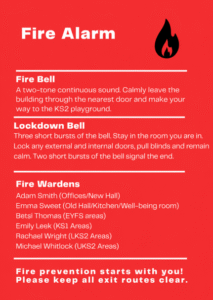
- If the fire alarm is activated all staff, students and visitors will evacuate the building using the nearest escape route and proceed to the fire assembly point in the KS2 playground.
- The alarm will be activated from either a smoke / heater detector being activated or by a manual call point.
- If a smoke/ heat detection activated the alarm will instantly sound.
- If a manual call point is activated the alarm will instantly sound.
- If safe to do so doors should be closed as persons leave, and if possible, windows too.
- In high-risk department all emergency shut off devices will activate e.g. gas cookers, design & technology equipment
- Students and visitors will follow instructions given by supervising staff and Fire Wardens, leaving the building by walking in a calm fashion.
- All staff are responsible for ensuring that any visitors to their departments evacuate safely in the event of a fire. The Premises Team will ensure that any contractor working on site are aware of what action to take in the event of fire and evacuate the building when the alarm sounds. This will be undertaken and recorded using the Contractor Logbook.
- Persons must remain at the assembly point until they are informed by either the fire brigade or a member of the leadership management team that it is safe to return to the building or be relocated
- When a fire occurs, the saving and preservation of life takes precedence over the salvaging of property. A member of staff’s first duty is to look after the students; this will mean the evacuation of the building to a place of safety.
- No individual Is expected to extinguish a fire unless confident and competent do so.
Personal Emergency Evacuation Plans (PEEP’s)
- A Personal Emergency Evacuation Plan (PEEP) will be developed by the teacher, phase leader, SENCO, or another designated staff member for any student or staff member with a temporary or permanent mobility or sensory impairment that may affect their ability to evacuate safely. The plan will be shared with relevant personnel.
- The purpose of a PEEP is to ensure individuals who cannot evacuate unaided receive the necessary information and support, and to inform departments so appropriate assistance is always available.
- Individuals unable to use stairs during an evacuation must proceed to the nearest fire refuge point and use the provided telephone to notify the responsible person of their location. They should remain there until further instructions are given, as outlined in their PEEP. The academy is responsible for ensuring effective communication and safe evacuation.
- If no designated refuge points are available, individuals should wait in a fire-protected lobby. Fire wardens must inform the responsible person at the assembly point if anyone is waiting in a refuge point or protected lobby.
Fire wardens
- The setting will appoint a sufficient number of fire wardens to oversee daily fire safety and assist during evacuations.
- Each fire warden will be assigned to a specific classroom, area, or floor. Staff must be aware of the fire warden responsible for their work area.
- When the fire alarm sounds, fire wardens must check their designated area to ensure it is clear, or delegate this to another member of staff, then report to the Responsible Person at the assembly point. Fire wardens are not expected to fight fires or put themselves at risk. All wardens will receive appropriate training to perform their duties safely.
- All staff must report fire safety concerns such as faulty fire doors, tampered extinguishers, or poor housekeeping to the Responsible Person.
- Further details on fire warden responsibilities can be found in the ‘Fire’ section of the Health and Safety Manual.
- Fire Warden Roles and responsibilities are detailed in appendix C.
Compliance inspections
- The Premises Team will carry out regular inspections of fire safety equipment, exit routes, and related systems, in line with the Fire Logbook / EdOps.
- Any defects or issues identified will be reported to the Premises Manager, who will arrange for repair, replacement, or replenishment as necessary.
- The fire alarm system will be tested weekly by the Premises Assistant. Each call point is numbered, and a different one will be tested each week, with results recorded in the logbook. All call points must be tested at least once annually.
- The fire alarm panel is tested and maintained annually under the compliance contract with BAM, subcontracted to Balmoral.
- Emergency lighting will be tested monthly by the Premises Manager or a compliance contractor, with results recorded in the logbook or EdOps. A full 3-hour battery test will be conducted annually as part of the compliance contract with BAM.
- The Premises Team is responsible for routine visual inspections of all firefighting equipment to ensure correct placement and that it has not been tampered with. These inspections will be formally recorded monthly in the fire logbook.
- All firefighting equipment is independently tested annually by BAM.
Fire Risk Prevention and Site Safety Measures
Portable Heaters
- Portable heaters will be managed in strict accordance with safety protocols to protect students, staff, and visitors.
- Only heaters that meet current safety standards and include automatic shut-off features may be used. They must be placed on stable, non-flammable surfaces and kept away from combustible materials such as paper, curtains, and furniture.
- Heaters are for short-term use only and must not be left operating in unoccupied rooms.
- Regular inspections and maintenance will be carried out, with clear guidelines provided on safe placement and usage, including ensuring heaters are switched off when not in use.
- Only oil-filled heaters may be purchased for use in the setting.
- A separate risk assessment for portable heaters will be completed and shared with staff.
Electrical Cable Management
- The setting will actively manage risks associated with poor electrical cable management, including the overloading of sockets, which can lead to overheating and fire hazards.
- Extension leads must be used correctly, and daisy chaining—the practice of connecting multiple extension cords or power leads together—must be avoided. Daisy chaining can overload circuits, increase electrical resistance, and generate excessive heat, all of which pose serious fire risks.
- Adequate power outlets will be provided to meet demand, and all electrical equipment will be regularly inspected and maintained.
- Staff and students will be educated on the dangers of overloading sockets and the correct use of electrical devices to ensure a safe learning environment
Electrical Devices
- Staff are not permitted to bring personal electrical items into the setting unless the item has a valid PAT test, bears a European Kite Mark, and has been approved by the Operations Manager.
- Unnecessary electrical appliances (e.g., computers, printers, TVs, fans, laminators) must be switched off and, where possible, unplugged when not in use.
- 3D printers and laser cutters must never be left unattended while operating.
- All portable electrical items must be PAT tested in line with HSE guidance and checked before use.
Lithium Batteries
- Lithium batteries are used in many items within the setting, including laptops, power tools, and mobile phones.
- Lithium batteries pose a greater risk if they are overcharged and must not be charged overnight.
- If there are clear signs of damage to equipment containing lithium batteries (e.g. a bulging laptop), the equipment must be taken out of use immediately and must not be used again until it has been repaired or replaced.
Flammable Substances
- All flammable substances which are stored on site will be kept in a flammable resistant cupboard. Quantities of flammable substance will be kept to a minimum
- If fuel is kept on site, no more than 20 litres can be held. The fuel will be stored in an outbuilding away from the main building
Combustible Materials
- To reduce fire risk, the setting will strictly control the storage of combustible materials in high-risk areas such as plant rooms, particularly those containing electrical panels or gas appliances.
- Items such as paper, cardboard, and flammable liquids must not be stored in these areas, as heat or sparks from equipment can significantly increase fire risk.
E- bikes and E Scooters
- E-bikes are permitted on site only if purchased from a reputable company.
- Self-modified e-bikes are not allowed on site under any circumstances.
- E-bikes must be stored outside, away from any external fire exits.
- Due to fire and road safety risks, e-scooters are not permitted on site.
Hot Works
- A permit will be issued to outside contractors for certain high-risk work activities involving hot processes i.e. re-felting of roofs, use of acetylene torches.
- The permit allows work to be undertaken for the specific activity and duration of the works. The setting will notify the Head of Estates, at least, 48 hours before commencing any type of hot works.
- All Hot Works to be reported to our Insurers via Head of Projects & Estates/ Facilities Manager / Estates Administrator before commencement.
Smoking on site
- Smoking is not permitted onsite
- Persons must go off site and find a discreet area away from the setting. Any person found smoking on the site could receive disciplinary action
- A no smoke sign is displayed at the main entrance
Location of specific site hazards
To provide clear information to staff and fire services a floor plan detailing the location of specific hazards will be in place with a copy kept in the fire emergency grab bag
Areas included on the plan:
- Main gas isolation points
- Main electrical isolation points
- Location solar panel inverter
- Location of radiation sources
- Location of gas and Oxyacetylene canister
Building Response to a Fire Alarm
On activation of the fire alarm the building will
- Initiate the fire Alarm, the alarm is a two-tone continuous system
- Visual beacons will flash
- The internal magnetically-locked doors will release
- Access control doors release
- In the event of an alarm the monitoring company will contact the academy within 3 minutes to confirm if the fire brigade needs to attend.
- Smoke vents will shut when the alarm sounds
- Ventilation systems will disable
- Fire shutters will close. Fire shutters are located in the kitchen.
- Emergency Lighting is activated
- Mains Gas valve is isolated/ closes
Inspection Procedures
- Regular inspections of fire safety equipment, exit routes etc. will be carried out by the premises team in accordance with the details in the Fire Logbook/EdOps.
- Any defects or shortcomings will be brought to the attention of the Premises Manager who will ensure the arrangements for replacement or replenishment.
- The fire alarm system will be tested weekly by the Premises Manager. Each alarm point will be numbered, and a different number will be tested each week and recorded in the logbook. It is important that all call points are checked in a 1 year period.
- The fire panel is annually tested and maintained as part of the Compliance contract with BAM.
- The emergency lighting (EL) will be tested monthly by the Premises Manager or compliance contractor and recorded in the logbook /Ed ops. An annual 3 hour test on the EL batteries will be as part of the compliance contract with BAM (Ed ops is the online software used by the CLF estate teams to log in house compliance records.
- The premises team will have responsibility to undertake a visual inspection routinely of all firefighting equipment to ensure that they are in the correct location and have not been tampered with. This will be formally recorded at a monthly frequency within the fire logbook.
- Firefighting equipment is independently tested on an annual basis by BAM.
Emergency Routes and Exits
- All emergency exits are to be kept clear and free from obstructions at all times.
- All fire exits should be clearly signed, and comply with legislation e.g. should be pictorial rather than just written
- If lettings take place and they move /use equipment, they must not block fire exits.
- In each area there should be a diagram showing exit and assembly points.
- There is 1 metre clearance to the routes of exit doors.
Signage
- Fire safety signs are displayed (fire action notices, evacuation direction signs, assembly point signs and fire extinguisher signs).
- All signs comply with appropriate safety sign legislation – BS 5499.
Fire Arrangements Sign Off Section
Signed (Responsible Person):

Name: Adam Smith
Date: 1st September 2025
Appendix A
Responsible Persons for Fire Management
The Regulatory Reform (Fire Safety) Order 2005 requires the ‘responsible person’ for a premises to ensure that all fire safety facilities, fire equipment, fire devices and fire management systems are tested, inspected maintained, in effective order and well managed.
The “responsible person” is as follows:
For academies, the responsible person is the Principal. However, for buildings that are owned by third-parties such as BCC or NSC the responsible person has joint responsibility with the third-party owner and their appointed facilities team.
It is down to the responsible person to appoint a deputy to ensure fire safety in their absence.
In short, the ‘responsible person’ must ensure the safety of staff, students, contractors and visitors by managing the:
- Fire safety policies and procedures
- Fire risk assessment
- Fire drills and roll call of persons working or visiting the academy
- Means of escape
- Fire alarm systems
- Emergency lighting
- Fire doors and compartments
- Fire extinguishers
- Fire signs
- Statutory requirements for compliance; to ensure all workplace equipment is in safe working order.
- Hazardous or flammable substances, if appropriate.
- Fire training for staff and students
- Communicating with emergency services, in the event of a fire
- Fire management records, including the fire logbook.
The management of the items above can be delegated to the Operations Manager, Premises Manager, Premises Staff, Department Heads etc. Clearly day-to-day responsibilities will be delegated; however, the responsible person must ensure suitable and sufficient fire management systems are being undertaken.
Appendix B
Checklist for duties of Persons Responsible for fire safety
| Role |
Person Responsible
|
In Case of Absence |
| Responsible Person |
Adam Smith |
Emma Sweet |
| Fire safety training, induction and revision |
Lydia Devereaux |
Adam Smith |
| Fire risk assessments |
Lydia Devereaux
Richard Palmer |
Adam Smith
Christopher Welch |
| Conducting Fire drills |
Lydia Devereaux
Richard Palmer |
Adam Smith
Christopher Welch |
| Updating of logbook / recording |
Lydia Devereaux
Richard Palmer |
Adam Smith |
| Weekly call point testing |
Christopher Welch |
Richard Palmer |
| Monthly emergency lighting testing |
Christopher Welch |
Richard Palmer |
| Fire escapes unobstructed |
Christopher Welch |
Richard Palmer |
| Check all fire detection and protection systems are maintained |
Christopher Welch |
Richard Palmer |
| Fire Wardens |
Adam Smith
Emma Sweet
Betsi Thomas
Emily Leek
Michael Whitlock
Rachael Wright
|
|
Appendix C
FIRE WARDENS – KNOW YOUR ROLE
| Fire safety awareness |
Ensure good housekeeping practices are conducted |
| Firefighting equipment |
Ensure visual checks are conducted to identify any damaged firefighting equipment |
| Fire doors |
Ensure fire doors are closed or where appropriate self-closing systems will close a fire door when an alarm is activated. |
| Emergency lighting |
Ensure visual checks are conducted to identify if emergency lighting is available and working. (Instruction on identifying green / orange LEDs of particular lights may be required) |
| Manual Break Glass Call points |
Ensure manual break glass call points are located adjacent to fire exit doors and are not obstructed by displays, coats etc. |
| Electrical equipment |
Whenever possible, switch off any electrical equipment. |
| Escape routes |
Ensure all escape routes are clear of obstructions and signs are not damaged or obscured. Alternative escape routes should be known and used when the primary route is blocked. |
| Final exit doors |
Ensure all final exit doors can be opened and if necessary, instruct students how to use any push bars, thumb turn locks. |
| Mandatory fire notices |
Ensure all fire doors are clearly signed “fire door keep shut” |
| Fire safety signs |
Ensure all fire safety signs are legible and correctly signpost emergency exit directions |
| Assembly point |
Ensure you are aware of the location. Conduct a head count of the students within your group / class. Inform the head teacher / responsible person if anyone is missing / unaccounted for. |
| End of day |
Switch off any electrical equipment, heaters etc. Ensure any waste has been disposed of safely. Windows are securely closed. Ensure all final exit doors and fire doors are closed. |
Appendix D
FIRE EMERGENCY PROCEDURES
If any member of staff or a student discovers a fire, they must sound the fire alarm by breaking the nearest red break glass call point. When the fire alarm sounds (two-tone siren) leave the academy / academy by the nearest available exit.
Proceed to the designated assembly point, which is in the KS2 playground.
All staff should:
- Ensure all members of their group leave the building immediately using designated fire exit routes.
- Assist with the evacuation of any individuals who require it.
- Proceed to the assembly point and wait for further instructions.
- Persons must remain at the assembly point until they are informed by either the fire brigade or a member of the leadership management team that it is safe to return to the building or be relocated
A nominated person should contact the emergency services on 999 as soon as possible.
Adam Smith, Waycroft Academy, Seldon Road, Stockwood, Bristol, BS14 8PS.
- Explain the nature of the emergency, numbers of students & staff evacuated, contact mobile number and any other relevant information. Do not hang up until all information has been confirmed.
- The reception or office staff will take the fire registers, form registers, absentee lists and staff signing out books to the assembly point.
- Members of the senior leadership team will check that all staff, students, and visitors have been evacuated safely and are accounted for.
- First aiders will deal with any first aid requirements.
- The person responsible or a member of the senior leadership team will inform the Premises/on-site facilities team of any location and nature of a fire, persons missing, and persons in refuge points and will not allow anyone to re-enter buildings until informed that it is safe to do so by The Fire Rescue Services or Premises/on-site facilities team.
- On receiving the ‘all clear’ from the Fire Rescue Services or Principal / Principal, inform all staff that they may return to the building.
- If required, the Principal, Vice Principal, in conjunction with the CLF Senior Leadership Team and Chair of Academy Council will take the decision to close the academy after assessing the situation.
Appendix E
Appendix F