This Accessibility Plan (Plan) has been drawn up in consultation with the Cabot Learning Foundation and SENDCo of the Academy and covers the period from November 2026 – November 2029. The plan is available in large print or other accessible format if required.
The plan takes account of the Academy’s public sector equality duty set out in section 149 of the Equality Act 2010 – Schedule 10 of the Equality Act 2010 places specific duties on schools in relation to disabled pupils, requiring them to plan proactively to improve access to the curriculum, the physical environment and information. These duties support schools in meeting their wider responsibilities under Section 149 (the Public Sector Equality Duty), particularly in advancing equality of opportunity for disabled pupils.
We are committed to fostering a culture of equity, belonging and inclusion, where diversity is valued and all members of the community are supported to participate fully in academy life. We recognise our responsibility to anticipate and remove barriers experienced by disabled pupils, staff, parents, carers and visitors. This Accessibility Plan supports our work to improve access to the curriculum, the physical environment and information, while promoting participation, independence and positive outcomes for all.
Accessibility planning is an important part of the Academy’s approach to inclusion. The actions within this plan are intended to support continual improvement and ensure that accessibility considerations form part of wider academy development and school improvement planning.
The Academy is committed to ensuring that disabled pupils, families and other stakeholders have opportunities to contribute to the identification of priorities and the review of progress, recognising that meaningful participation strengthens accessibility planning and supports more inclusive outcomes.
The Academy’s layout and facilities

The Academy is committed to making reasonable adjustments to allow disabled pupils to access educational provision at the Academy.
We plan, over time, to increase the accessibility of provision for all pupils, staff and visitors to the Academy in the following areas:
Attached are three action plans relating to the above. These will be reviewed as and when necessary. It is acknowledged that there will be need for ongoing awareness training for all staff in the matter of disability discrimination and the potential need to inform attitudes on this matter.
The Accessibility Plan should be read in conjunction with the following policies, strategies and documents:
The Plan will be monitored by the Academy Council. There will be a full review of the Plan in November 2029 when a new Plan will be produced to cover the next three years.
Welcoming and preparing for disabled pupils
Where it is practicable to make reasonable adjustments to enable a prospective pupil to take up a place at the Academy and to satisfy the current admissions criteria, the Academy is committed to providing those reasonable adjustments.
To meet the needs of disabled pupils, the Academy requires full information. The Academy will ask prospective pupils to disclose whether they have received any learning support, have had an educational psychologist’s report or have any disability or other condition of which the Academy should be aware. Where a pupil has an Education, Health and Care (EHC) plan the Academy will work with the Local Authority (LA) which makes and maintains the EHC plan to ensure that the identified provision is delivered appropriately.
In assessing the pupil or prospective pupil, the Academy may need to take advice and require assessments as appropriate. The Academy will be sensitive to any issues of confidentiality.
Developing this Accessibility Plan
This Accessibility Plan has been informed by a review of the academy’s current accessibility arrangements, information and data, previous Accessibility Plan actions, and stakeholder views where appropriate. The academy may use the Accessibility Review Checklist (Appendix B) to support this process.
Participation and Engagement
The Academy recognises the importance of meaningful participation in accessibility planning. The identification of priorities and review of progress may be informed by the views and experiences of pupils, parents/carers, staff, governors and, where appropriate, external professionals. Consideration should be given to the voices of disabled pupils and their families.
Monitoring and Review
Progress against the actions identified within this plan will be reviewed annually by academy leaders and reported to the Academy Council. The findings of this review will inform updates
to the plan and future accessibility priorities. A full review and renewal of the plan will take place every three years.
| Vision and values: the purpose and direction of the academy’s plan
Waycroft Academy is committed to providing an inclusive, ambitious and accessible learning environment where every pupil can thrive and achieve their full potential. In line with the Equality Act 2010, the academy seeks to remove barriers to participation, learning and achievement for pupils with disabilities and additional needs. The Accessibility Plan supports Waycroft’s vision of ensuring that all pupils are valued, respected and able to participate fully in school life. Through a graduated and inclusive approach, Waycroft aims to: · Increase access to the curriculum for all pupils · Improve and maintain access to the physical environment · Enhance the availability and accessibility of information for pupils, families and visitors · Promote equality of opportunity, independence and wellbeing · Foster a culture where diversity is celebrated and all members of the school community feel included and supported. The plan reflects Waycroft’s commitment to high expectations, inclusive practice and collaboration with families and external agencies to meet the needs of all learners. |
| Gathering views: the views of those consulted during the development of the plan – key findings from gathering views of pupils, parents, academy staff and those working with the school
The development of this Accessibility Plan was informed through discussions with pupils, parents and carers, academy staff and external professionals who work alongside the school. Key findings included: Pupils · Pupils value supportive relationships with staff and feel that adults help them when they experience difficulties. · Pupils reported that visual supports, structured routines and adapted resources help them access learning effectively. · Some pupils highlighted the importance of quiet spaces and sensory regulation opportunities during the school day including movement breaks within the classroom. Parents and Carers · Parents expressed appreciation for the school’s inclusive ethos and the support provided from the SENCO. · Families identified clear communication and timely sharing of information as important factors in supporting their children’s progress, including within SEND meetings with parents/carers and teachers. Staff · Staff recognised the benefits of ongoing professional development in SEND, neurodiversity, communication needs and adaptive teaching. · Staff highlighted the positive impact of visual supports, assistive technologies and personalised approaches to learning. External Professionals and Partners · External agencies emphasised the importance of early identification, multi-agency working and consistent implementation of recommendations. · Partners supported the continued development of inclusive practice, reasonable adjustments and accessible learning environments. These views have informed the priorities identified within this Accessibility Plan and will continue to shape future developments.
|
| Information and data: pupil data and school audit – key finding from gathering information and data
The academy reviewed pupil data, SEND records, attendance information, curriculum access arrangements and feedback from stakeholders to identify areas of strength and priorities for improvement. Key findings included: · The academy supports a high number of pupils with special educational needs and disabilities, including pupils with Communication and Interaction needs, Cognition and Learning needs, Social, Emotional and Mental Health needs and Sensory and Physical needs. · Most pupils with SEND can access the curriculum successfully through adaptive teaching, targeted interventions and reasonable adjustments. · The school environment is generally accessible, with appropriate arrangements in place to support mobility, safety and inclusion. · Visual resources, assistive technology and communication supports are used effectively to increase participation and independence. This is an ongoing focus in the school. · Staff demonstrate a commitment to inclusive practices and engage regularly in training and conversations to develop their knowledge and skills. · Analysis of attainment, progress, attendance and participation data indicates the need to continue reducing barriers for vulnerable groups and promoting equitable outcomes for all pupils. The findings from the audit have informed the objectives and actions detailed within this plan and will be reviewed regularly to ensure continuous improvement and compliance with statutory requirements.
|
| Priority / Objective | Evidence Informing priority | Actions | Outcome/Success Measure | Timescale | Review of Progress | Date of Review | |
| Short term | Enable staff to increase their knowledge and understanding of needs of disabled pupils and differentiating the curriculum. | Staff feedback identified a need for ongoing professional development in SEND, neurodiversity, communication needs and adaptive teaching. School data shows a significant proportion of pupils have SEND and require personalised approaches, reasonable adjustments and curriculum adaptations to access learning successfully. |
|
Staff confident in providing appropriate teaching and support to more fully meet the requirements of disabled pupils’ needs with regards to accessing the curriculum. | July 2027 |
|
|
| Medium term | Enable children to access the outdoor areas for outdoor learning
|
Pupil voice highlighted the importance of access to sensory regulation opportunities and movement throughout the school day. The academy is committed to ensuring all pupils can participate fully in learning experiences and enrichment opportunities, including outdoor learning. |
|
All pupils in the school access all learning and wellbeing opportunities the outdoor and forest school offers. | July 2028 | ||
| Long term | Ensure staff plan to meet the needs of all children for residential trips in advance so activities can be adapted and staffing adjusted accordingly | Review of participation and inclusion priorities identified the need to continue reducing barriers to participation for vulnerable groups. The academy seeks to ensure disabled pupils can access all aspects of school life, including trips, camps and enrichment activities, through appropriate planning and reasonable adjustments.
|
|
Staff have proactively met parents to plan early enabling children with additional needs to access camps successfully (Y2, Y4, Y6). | July 2029 |
| Priority/Objective | Evidence Informing Priority | Actions | Outcome/Success Measure | Timescale | Review of Progress | Date of Review | |
| Short term | Ensure classrooms are language rich but appropriate for children’s sensory needs | Pupil voice identified the importance of environments that support sensory regulation and wellbeing. Staff recognised the positive impact of visual supports and carefully planned learning environments. Accessibility reviews identified the need to continue considering sensory factors within classrooms and communal areas.
|
|
All areas of the academy are conducive to learning.
|
July 2027 | ||
| Medium term | Provide a range of play equipment for disabled pupils to use during break and lunch times. |
Pupil feedback highlighted the importance of inclusive opportunities during social times. The academy aims to promote equality of opportunity and participation for all pupils through accessible environments and resources. |
|
Range of activities available during unstructured times. Children access social times without less opportunities to play than their peers. | July 2028 | ||
| Long term | Provide accessible toilet and changing facilities for toilet training in the preschool. | School accessibility review identified the need to maintain and improve accessibility of the physical environment for pupils with sensory and physical needs. SEND data demonstrates the need for facilities that support independence, dignity and inclusion for all learners. |
|
To support all children with their toilet training in the preschool. | July 2029 |
| Objective/Priority | Evidence Informing Priority | Actions | Outcome/Success Measure | Timescale | Review of Progress | Date of Review | |
| Short term | Ensuring availability of written material in alternative formats, when necessary. |
Parents identified clear communication and accessible information as important in supporting their children. The academy is committed to improving the availability and accessibility of information for pupils, families and visitors. |
|
Children will be able to access their learning through appropriate written material. | July 2027 | ||
| Medium term | Improve IT provision for disabled pupils. |
Staff identified the positive impact of assistive technology and personalised approaches to learning. School audits showed that visual resources, communication supports and technology are effective in increasing pupil participation and independence and remain an area for continued development. |
|
Disabled pupils readily have access to IT resources to meet their needs | July 2028 | ||
| Long term | The accessibility plan takes into account the views of pupils with a disability as they move through the school. | Consultation activities highlighted the importance of pupil voice in identifying barriers and informing future accessibility priorities. The academy is committed to ensuring that disabled pupils and their families contribute to accessibility planning and review processes. |
|
The accessibility plan has taken the views of children into account, children feel heard. | July 2029 |
Information Gathering:
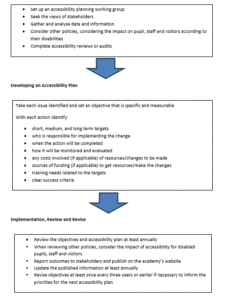
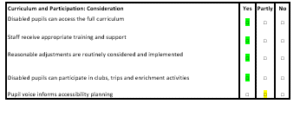
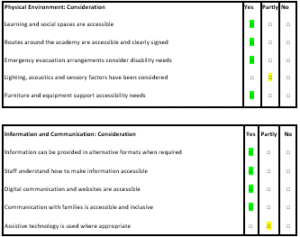
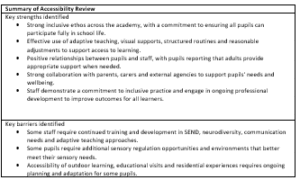
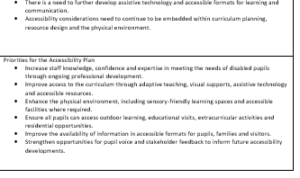
This checklist may be used to support the development and annual review of the Accessibility Plan.
Evidence and Information Considered
Indicate which sources have informed this plan:
☐ Pupil voice
☐ Parent/carer feedback
√ Staff feedback
√ SEND reviews or self-evaluation
√ Attendance data
√ Behaviour and exclusion data
☐ Participation in clubs, trips and enrichment activities
√ Accessibility of the Curriculum (see further checklist)
√ Accessibility of the physical environment (see further checklist)
√ Accessibility of communication and information (see further checklist)
√ Previous Accessibility Plan review
√ Advice from external professionals/agencies
√ Academy improvement priorities
☐ Other: ___________________________